
Perry County Projected Release Dates
“Projected release date” is not one official Tennessee field. A jail estimate, Release Eligibility Date, Sentence End Date, parole hearing date, and actual release timestamp all answer different questions. TDOC's FOIL detail template does not use “Projected Release Date” or “Tentative Release Date” as its exact label. Copy the label shown on the live record.
A pretrial detainee has no sentence-based release date. Bond, recognizance, dismissal, a court order, or transfer may end the Perry jail stay. A sentenced person has a legal term that can be calculated, yet release may still depend on credits, statutory limits, parole action, and holds. The actual iSOMS Release Date confirms an exit from Perry County Jail only after it occurs.
Find Perry County Release Dates
Start with the judgment and custodian. Perry County Jail can hold pretrial detainees, locally sentenced people, and TDOC backup prisoners. A person shown as TDOC class may be serving a state sentence while still housed locally. The search route therefore follows legal custody rather than the building alone.
- Identify the booking, court case, and whether the person is pretrial, locally sentenced, or TDOC classified.
- For a county case, review the Perry court judgment for sentence length, offense date, jail credit, and concurrent or consecutive terms.
- Ask Perry County Jail for the recorded local release calculation and applicable credit policy. No public Perry-specific good-time policy was found.
- For a TDOC felony record, open FOIL and search by TOMIS number when possible. Read the full detail record.
- Copy Release Eligibility Date and Sentence End Date separately. Also note supervision status, hearing result, and active sentence data.
- Check for amended orders, holds, transfers, or Board action. Confirm the actual exit with the custodian when it occurs.
The Perry County released-inmate lookup routes help trace what happened after a date passes, including transfer to another agency.
Tennessee Release Credit Calculations
T.C.A. § 40-35-501 governs felony release eligibility. The controlling rule depends on the offense, offense date, classification, and statutory subsection. Public Chapter 988 changed service rules for listed offenses, including full-service requirements for some and minimum-service rules for others. It is inaccurate to say all Tennessee inmates serve 85 percent.
T.C.A. § 41-21-236 governs TDOC sentence-reduction credits. For eligible records, the statute permits credits under TDOC criteria for good conduct and satisfactory program performance, subject to review, loss, or restoration. Credits cannot override a statute that sets a mandatory floor. Some offense regimes allow only limited retained credits, while others remove release eligibility. The exact subsection and offense-date window control.
For felony offenders serving at least a year in a local jail or workhouse, the statute extends a good-behavior-credit framework under the law and TDOC rules. For misdemeanor local terms, the sentencing court sets a release percentage within the statutory range, and credits are limited as the statute directs. Perry County has not published a local policy in the source set, so only the jail and judgment can supply the actual local calculation.
Perry County Release Date Changes
A date may change when new legal or correction data reaches the timekeeper. FOIL warns that sentence dates can change as more court documents arrive. A shift does not itself prove an error. Compare the current label, lookup date, judgment, and sentence details before asking the jail or TDOC for an explanation.
| Factor | Possible effect |
|---|---|
| Jail credit audit | Adds or corrects credit for time already confined |
| Earned credit | May move eligibility within the controlling statutory limits |
| Disciplinary action | May cause credit loss or later restoration |
| Amended judgment | Can correct sentence length, alignment, or credit |
| Concurrent or consecutive terms | Changes how multiple sentences combine |
| Parole action | A grant, denial, deferment, or rescission affects the release path |
| Detainer or hold | May cause transfer to another custodian on the expected date |
Escape time, a new sentence, and other lawful adjustments can also change the calculation. A parole grant may precede physical release while staff review the release plan. A detainer can turn an expected community release into a handoff.
Confirm Perry County Actual Release
When an expected date arrives, check the custodian that held the person. For Perry County Jail, iSOMS uses a populated Release Date to record an exit from that booking. Ask the jail for release disposition and destination if the public card does not state them. Then compare the court order. For a TDOC person, reopen FOIL and read status, assigned location, and release fields together.
A Perry County VINELink release alert can report a custody event from a participating agency. It may lag and does not prove destination. If the alert says transfer, check the receiving agency. If it says release, verify the official record. For federal prison custody use the BOP locator, while immigration detention requires ICE's current locator and follow-up.
- Release Eligibility Date
- The earliest point for parole consideration under the sentence calculation.
- Sentence End Date
- The calculated expiration of the sentence.
- Parole Hearing Date
- A scheduled proceeding, not a promised release day.
- Detainer
- A request or hold that may lead to another agency taking custody.
Perry County FOIL Date Fields
FOIL may show Supervision Status, Assigned Location, Combined Sentence Length, Sentence Begin Date, Sentence End Date, Release Eligibility Date, Parole Hearing Date, Parole Hearing Result, and active Tennessee sentences. Field availability varies. A result marked parole points to release under conditions. Probation indicates court-linked community supervision. Inactive means TDOC no longer records active supervision, but the surrounding dates explain the record.
Use a TOMIS or SID number when legitimately known. A name search can include aliases, race, and other filters, but identity should be matched with birth date, physical description, offense, and sentence data. Open the official TDOC FOIL search for the current detail. A field office listed as Assigned Location is not a prison when the supervision status is parole or probation.
The official TDOC policy library provides current release and transfer policy context.
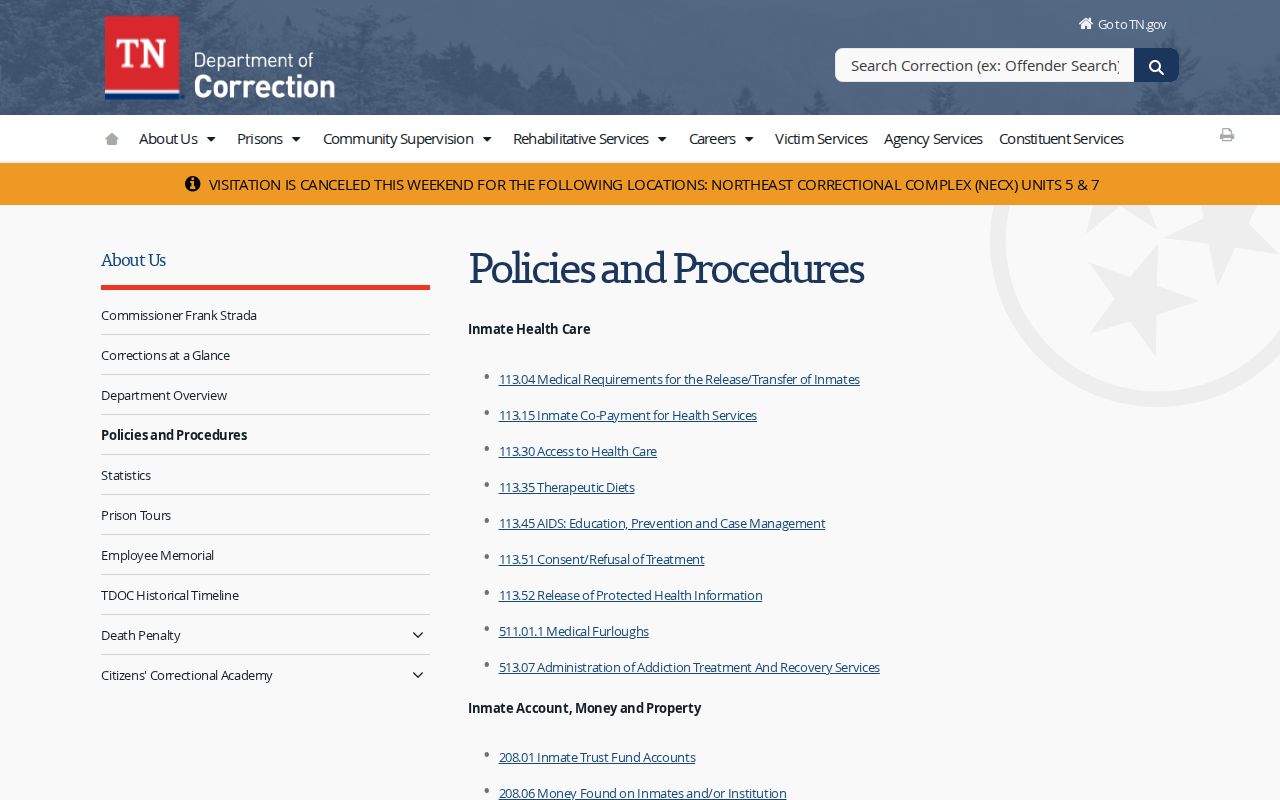
The policy source supports the need to check current TDOC rules instead of treating a saved estimate as final.
Perry County TDOC Backup Dates
Perry's monthly jail reports show that the jail houses TDOC backup prisoners. Those reports are population snapshots, not individual release records. Their value is structural: a person can be physically in Perry County Jail while TDOC remains responsible for the felony sentence calculation.
If iSOMS shows a TDOC class, compare FOIL with the judgment. A disappearance from the county roster may mean transfer to a state institution. If FOIL still says incarcerated at another location, no community release occurred. If it shows parole, probation, or inactive, preserve the exact label and dates before describing the outcome.
This local overlap makes destination checking essential. Ask whether the jail exit was release or transfer, then identify the receiving agency. The county release timestamp and the state sentence calculation can both be correct while answering different questions.
Perry County Sentence Date Rules
For offenses before or after key statutory effective dates, the same sentence length can produce a different eligibility rule. T.C.A. § 40-35-501 contains several offense-specific regimes, including provisions that require full service or limit how credits affect eligibility. T.C.A. § 39-13-523 separately requires entire-sentence service for specified offenses. Each citation must be checked against the version in force on the offense date.
Under parts of § 41-21-236, credits may affect eligibility without changing sentence expiration. That is why FOIL can properly show an eligibility date and a later end date. The sentencing judge sets the classification, TDOC serves as the official timekeeper for state sentences, and the Board acts on discretionary parole where the law permits it.
A sound calculation obtains every judgment, identifies concurrent and consecutive terms, confirms pretrial credit, applies the correct offense-date statute, and then checks TDOC credits and Board action. Only the responsible jail or TDOC can state the current official calculation.
Perry County Parole Date Differences
A Release Eligibility Date is not a parole grant. It marks the earliest parole-consideration point under the sentence calculation. The Board may schedule a hearing after TDOC certifies eligibility, then grant, deny, defer, or take another authorized action. A hearing date is therefore separate from both eligibility and the expected physical release.
Even after a grant, TDOC explains that release-plan approval and other pre-parole requirements can remain. A detainer may also cause transfer on the date the prison term would otherwise permit release. If the Board later rescinds a grant, the anticipated date can disappear. Read the current FOIL Parole Hearing Result and obtain the final Board decision when the field is incomplete.
Probation presents another distinction. It may be ordered instead of prison or after the jail part of split confinement. The start of probation can coincide with release from one custodian, but it does not mean the sentence record is inactive. FOIL may list a field office as the Assigned Location. That denotes community supervision, not confinement at the office.
Request Perry County Release Calculations
For a local sentence, ask the jail for the booking identifier, recorded release calculation, jail-credit total, applicable credit policy, release disposition, and destination if transferred. Pair that response with the judgment from the Perry County court file. No official public counter hours, local fee schedule, or Perry-specific written good-time policy was located, so call 931-589-8803 before sending a request.
For a state sentence, TDOC is the timekeeper. An archived-record request may require the person's full name, TOMIS number, and date of birth. Request only the identifiers needed to match the record. A current FOIL screenshot is useful for preserving labels, but the agency record controls when later court documents or credit audits change the calculation.
Ask for the date label exactly as maintained. “Eligible for parole,” “sentence expires,” and “released” must not be merged into one answer. When multiple sentences exist, ask how they align and whether any hold affects destination. A short written response tied to a booking or TOMIS number is more useful than an informal estimate with no source date.
Tennessee Public Records Act access does not guarantee that every correction detail is open. Request the segregable public portion and allow the custodian to apply lawful exemptions. If prompt production is not practical, T.C.A. § 10-7-503 supplies a response framework. Copy charges, if any, fall under the custodian's current policy and T.C.A. § 10-7-506.